 Menu
Menu
Type the name of almost any country into Google Maps and the satellite view will reveal a patchwork of fields, orchards, and cultivation stretching in every direction. Do the same with Iran and something strange happens. Vast stretches of territory appear as blank, featureless terrain. Villages materialise without surrounding farmland. Valleys that geographers have documented as some of the most fertile in the Middle East show up as empty brown plains. Yet Iran is the world's largest producer of pomegranates, the second largest producer of dates, and the source of roughly 40 percent of all pistachios consumed on Earth. The food is real. The farms are real. They simply do not appear on the most widely used mapping platform in the world.
To understand how this came to be, and to understand the extraordinary agricultural civilisation that lies beneath those blank satellite tiles, it is necessary to travel back several thousand years, to the river plains of ancient Mesopotamia and the mountain valleys of the Iranian plateau.
The First Farmers: Mesopotamia and the Iranian Plateau
The story of Iranian agriculture does not begin in Iran as we know it today. It begins in the arc of fertile land stretching from the Zagros Mountains westward into the plains of Mesopotamia, the region known to historians as the Fertile Crescent. Around 10,000 years ago, communities in this region were among the first on Earth to make the transition from hunting and gathering to settled agriculture. The wild ancestors of wheat and barley grew along the foothills of the Zagros range, in what is today western Iran. Goats and sheep were first domesticated on these same slopes. The people who made those domestications were, in a very real sense, the original Iranian farmers.
By 6000 BCE, agricultural settlements had spread across the Iranian plateau. Sites such as Chogha Mish in the Khuzestan plain and Tepe Sialk near present-day Kashan show evidence of sophisticated grain storage, ceramic vessels for preserving food, and early canal systems designed to distribute water from mountain rivers across flatter lowland terrain. The Iranian plateau is not naturally kind to agriculture. It is largely arid, ringed by mountains that trap moisture on their windward slopes while leaving interior basins dry. The people who farmed it learned very early that water management was not a convenience but a matter of survival.
The most remarkable solution they developed was the qanat. A qanat is an underground aqueduct, hand-dug through rock and compacted earth, that channels groundwater from a point high on a mountain slope down through a gently sloping tunnel to emerge at a lower elevation, sometimes many kilometres away, where it can irrigate fields and fill village reservoirs. The earliest known qanats date to around 3000 BCE, and at their peak there were more than 50,000 of them in active use across Iran. Many are still functioning today. The UNESCO-recognised Persian qanat system is one of the most ingenious pieces of agricultural engineering in human history, and it is the reason that cities, orchards, and grain fields exist in places that would otherwise be uninhabitable desert.
The qanat was not merely a piece of infrastructure. It was the foundation on which Iranian civilisation was built. Wherever a qanat ran, a village grew. Where villages gathered, cities rose.
The Achaemenid Empire and the Organisation of Agriculture
By the sixth century BCE, the Achaemenid Persian Empire had unified the Iranian plateau and surrounding territories into the largest empire the world had yet seen. Agriculture under the Achaemenids was a managed affair. The state maintained detailed records of grain production, livestock counts, and water rights. Royal estates, known as paradeisos, from which the English word paradise is derived, were walled gardens and orchards that cultivated fruit trees, herbs, and decorative plants brought from every corner of the empire. These royal gardens were not merely aesthetic projects. They functioned as experimental agricultural stations, introducing new cultivars and growing techniques to regions where they had not previously been practised.
The Achaemenid period saw the deliberate spread of crops across the empire. The date palm, long cultivated in Mesopotamia and the Persian Gulf lowlands, was encouraged in the oases of the interior. Vineyards that had existed on a small scale in the Zagros foothills were expanded. Pomegranates, native to the region spanning eastern Iran and Central Asia, became a symbol of Persian royalty and were cultivated widely across the empire's western territories, eventually spreading into the Mediterranean world.
Wheat, barley, and millet remained the staple crops, with production concentrated in the better-watered provinces of Fars, Media, and the Caspian lowlands. The Achaemenid tax system, which required payment partly in kind, ensured that agricultural surplus was systematically extracted, stored, and redistributed, creating the logistical backbone that allowed the empire to maintain large armies and build ambitious infrastructure across a vast and geographically diverse territory.
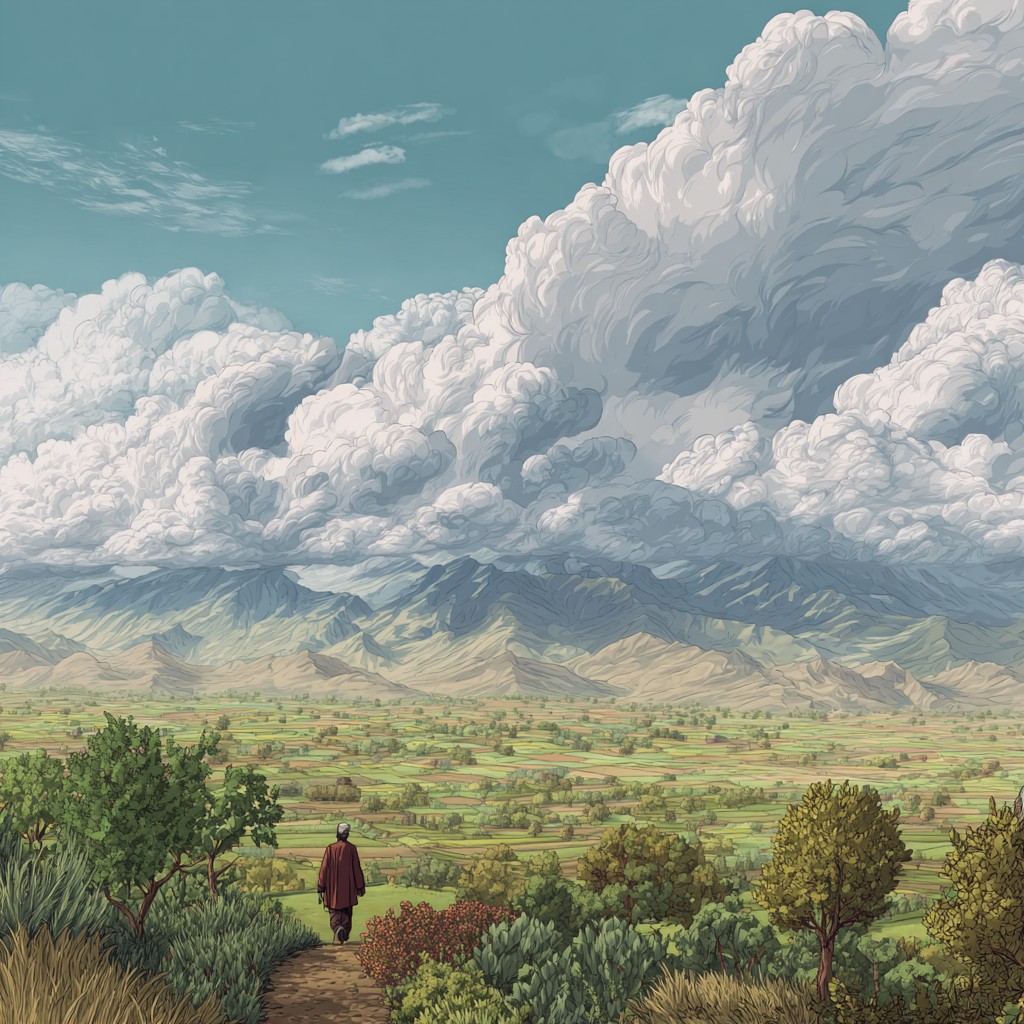
The Islamic Golden Age and Agricultural Transformation
The Arab conquest of Persia in the seventh century CE did not disrupt agriculture so much as redirect and enrich it. The new Islamic caliphate brought Iran into contact with agricultural knowledge from across a far wider network, connecting Persian farming traditions to those of Egypt, the Levant, India, and eventually Spain. Iranian agronomists and scholars contributed substantially to what historians call the Islamic Agricultural Revolution, a period between roughly 700 and 1100 CE during which crops, techniques, and knowledge were transmitted across the Islamic world at an unprecedented rate.
Cotton, which had been grown in limited quantities in eastern Iran and what is today Pakistan, spread westward through this network. Sugar cane moved from South Asia through Iran and into the Mediterranean. Citrus trees, sorghum, hard wheat, and a range of new vegetable crops followed similar routes. The Iranians were not merely conduits for these transfers. They adapted and improved the crops they received, developing new varieties suited to the plateau's climate, and they refined the water management systems that made intensive cultivation possible in semi-arid environments.
By the tenth and eleventh centuries, cities such as Nishapur, Isfahan, and Shiraz were surrounded by intensively cultivated farmland producing grain, fruit, cotton, and silk. The Caspian coastal provinces of Gilan and Mazandaran, with their subtropical climate and abundant rainfall, were producing rice, tea, and citrus on a scale that supplied much of the interior plateau. Saffron, derived from the dried stigmas of the Crocus sativus flower, had been cultivated in the Khorasan region for centuries and had become one of Iran's most valuable agricultural exports, traded along the Silk Road as far as China and Europe.
Nader Shah and the Disruption of the Agricultural Order
The eighteenth century brought one of the most dramatic disruptions in Iranian agricultural history in the form of Nader Shah Afshar. Rising from humble origins in Khorasan, Nader fought his way to absolute power, expelling the Afghan occupiers who had sacked Isfahan in 1722, restoring the Safavid monarchy before discarding it, and launching a series of military campaigns that at their peak extended Iranian control from the Caucasus to the banks of the Indus. His conquest of the Mughal Empire in 1739 brought legendary plunder, including the Peacock Throne and the Koh-i-Noor diamond, back to Iran.
The agricultural consequences of Nader's reign were largely catastrophic. His wars required enormous quantities of provisions, draught animals, and labour, all of which were extracted from the peasant farming communities that formed the backbone of the rural economy. Entire villages were stripped of their able-bodied men for military service. Livestock were commandeered. Grain stores were emptied. In many regions, the qanat systems that required constant maintenance fell into disrepair as the workforce needed to upkeep them was diverted elsewhere. Fields that had been cultivated for generations went unplanted.
The depopulation of agricultural regions during Nader's campaigns created conditions from which some areas took generations to recover. The Khorasan province, which had been one of Iran's most productive agricultural heartlands, suffered particularly severe disruption. Villages that had sustained continuous cultivation for centuries were abandoned. Water management infrastructure that predated the Islamic conquest crumbled. When Nader was assassinated in 1747 and the empire fractured, the agricultural base of the country was significantly weaker than it had been at the start of his reign.
The Qajar Dynasty: Stagnation and Reform
The Qajar dynasty, which ruled Iran from 1789 to 1925, presided over a period of profound tension between the traditional agricultural order and the pressures of modernisation, foreign competition, and internal political fragmentation. The Qajars were largely absentee rulers of the land question. Agricultural land remained concentrated in the hands of a relatively small number of large landowners, tribal chiefs, and religious endowments, while the majority of cultivators worked as sharecroppers under arrangements that left them with little incentive to invest in long-term productivity improvements.
The integration of Iran into global commodity markets during the nineteenth century had complex effects on rural agriculture. The demand for cotton, opium, and tobacco as export crops encouraged some landowners to shift cultivation away from food grains, creating localised food insecurity even as export revenues grew. The construction of telegraph lines and, later, roads by foreign concessionaires began to connect previously isolated agricultural regions to wider markets, though the benefits of this connectivity were unevenly distributed.
The Constitutional Revolution of 1905 to 1911 brought significant intellectual energy to questions of land reform and rural development, but produced little concrete change in agricultural conditions. Foreign intervention, the discovery of oil at Masjed Soleiman in 1908, and the social upheaval of the First World War combined to keep fundamental agricultural reform off the agenda. Iran entered the twentieth century with an agricultural sector that was still largely organised around pre-modern sharecropping arrangements, dependent on ancient water management infrastructure, and structurally unable to feed its growing urban population without supplementary imports.
- c. 10,000 BCE: Wild wheat and barley domesticated in the Zagros foothills
- c. 3000 BCE: First qanat underground aqueducts constructed across the plateau
- 550 BCE: Achaemenid Empire organises agriculture at imperial scale; royal paradeisos spread crops across conquered territory
- 700 to 1100 CE: Islamic Agricultural Revolution; Iran as a hub of crop transfer and agronomic knowledge
- 1747: Collapse of Nader Shah's empire leaves agricultural infrastructure severely depleted in multiple provinces
- 1963: White Revolution land reforms redistribute large landholdings to smallholder farmers
- 1979: Islamic Revolution; agrarian policies shift, some state farms created, agricultural self-sufficiency emphasised
- 1990s to present: Expansion of greenhouse cultivation, pistachio and saffron exports dominate high-value agricultural trade
The White Revolution and Land Reform
The most decisive rupture in the modern history of Iranian land tenure came with the White Revolution of 1963, a package of reforms initiated by Mohammad Reza Shah Pahlavi under pressure from the United States and in the face of domestic opposition from both traditional landowners and religious conservatives. The centrepiece of the reform programme was land redistribution. Large landholdings above a certain threshold were broken up and sold to the sharecroppers who had previously worked them, with the government acting as intermediary. By the end of the reform process, millions of rural families had received title to land they farmed.
The results were more complicated than the programme's architects had anticipated. Many of the new smallholdings were too small to be economically viable as independent units. The credit, technical support, and market access that peasant farmers needed to make productive use of their newly acquired land were often absent. Some former landowners retained control of water rights even after losing the land itself, giving them leverage over their former tenants. Agricultural productivity grew in some regions but stagnated or declined in others, and the rural-to-urban migration that the reforms were partly designed to slow actually accelerated during the 1960s and 1970s as smallholders found their plots unviable and moved to cities in search of wage work.
The Pahlavi era did, however, bring substantial investment in large-scale irrigation infrastructure. Dams on the Karun, Dez, and Zayandeh rivers created new reservoirs that brought previously uncultivated lowland areas under irrigation, particularly in the Khuzestan plain. Agribusiness enterprises, some established in partnership with foreign investors, introduced mechanised cultivation and modern input systems into certain sectors. Sugar beet, cotton, and wheat production expanded significantly. Iran in the 1970s was not food self-sufficient, but it was producing a far greater agricultural output than it had at any previous point in its history.
The Islamic Republic and Agricultural Self-Sufficiency
The Islamic Revolution of 1979 and the subsequent eight-year war with Iraq reshaped Iranian agriculture in ways that are still playing out today. The revolution initially brought considerable disruption. Large agribusiness enterprises were nationalised or dismantled. Many technically skilled agricultural managers left the country. The early years of the Republic saw a genuine attempt to rebuild agriculture around smaller-scale, more self-sufficient units, with the state providing subsidised inputs and guaranteed purchase prices for staple crops.
The war with Iraq, which lasted from 1980 to 1988, devastated the agriculturally rich Khuzestan province. Irrigated farmland was flooded, burned, or turned into front-line terrain. Hundreds of thousands of rural inhabitants were displaced. The oil revenues that had previously subsidised agricultural imports dried up as the war consumed the national budget. Iran was forced to prioritise domestic food production as a matter of national security, and policies promoting wheat cultivation and livestock production were implemented across the country.
In the decades following the war, Iranian agricultural policy has been defined by two sometimes conflicting imperatives. The first is the drive for food self-sufficiency, particularly in staple crops such as wheat, rice, sugar, and cooking oil. The second is the expansion of high-value export agriculture in products such as pistachios, saffron, dates, and fresh fruits, which generate foreign exchange that the economy badly needs under the conditions of international sanctions. Both imperatives have shaped where crops are grown, how land is used, and where investment flows within the agricultural sector.
Where Iran's Farmlands Actually Are
Iran has approximately 18.5 million hectares of cultivated agricultural land, representing about 11 percent of the country's total territory. This figure rises to around 37 million hectares if permanent pasture and rangeland used for livestock is included. The distribution of this farmland is highly uneven, shaped by the availability of water and the configuration of mountain ranges that capture precipitation on their slopes.
The most productive agricultural regions fall into several broad geographic zones, each with its own distinctive character and crop profile.
The Caspian Coastal Provinces
Gilan and Mazandaran, the narrow strip of subtropical lowland between the Alborz Mountains and the Caspian Sea, receive annual rainfall of between 600 and 1,800 millimetres, making them by far the wettest part of Iran and the closest the country comes to a consistently humid agricultural environment. These provinces produce the overwhelming majority of Iran's rice, including the long-grain fragrant varieties such as Tarom and Domsiah that are prized throughout the country and exported to Iranian diaspora communities worldwide. The Caspian provinces also produce significant quantities of citrus fruits, kiwifruit, tea, olives, and silk. The landscape is intensively cultivated, with rice paddies occupying valley floors and fruit orchards covering hillside terraces.
The Azerbaijan Provinces and the Northwest
The northwestern provinces of East and West Azerbaijan, Kurdistan, and Kermanshah experience a cooler, more continental climate with adequate winter snowfall that recharges aquifers and rivers supplying summer irrigation. This region is one of Iran's most important grain-producing areas, with significant cultivation of wheat, barley, sugar beet, and sunflowers. The valleys of the Aras and Urmia river systems support orchards producing apples, grapes, walnuts, and stone fruits. Lake Urmia, once one of the largest salt lakes in the world, has shrunk dramatically due to upstream water extraction for agriculture, a stark illustration of the tensions between agricultural expansion and environmental sustainability that define modern Iranian land use.
The Zagros Mountain Valleys
The Zagros range running diagonally from the northwest to the southeast of Iran encloses a series of high valleys and basins that have been cultivated since the earliest days of settled agriculture. The provinces of Lorestan, Chaharmahal and Bakhtiari, Kohgiluyeh, and parts of Fars contain productive agricultural land watered by snowmelt rivers. Wheat and barley are the primary crops, supplemented by legumes, stone fruits, and in lower-elevation valleys, walnuts and figs. The area around Shiraz in Fars province has been associated with grape cultivation for millennia, and while wine production is no longer legal, dried grapes, grape juice, and raisins remain important products.
The Isfahan and Yazd Plateau
The central plateau around Isfahan, Yazd, and Kashan presents the most dramatic demonstration of how Iranian agriculture defies its natural environment. Annual rainfall in this region is typically below 150 millimetres, qualifying it as genuine desert by most definitions. Yet Isfahan has been surrounded by farmland and gardens for at least 2,500 years. The Zayandeh River, fed by snowmelt from the Zagros, was historically sufficient to irrigate the Isfahan plain, though the construction of dams upstream and the diversion of water to other provinces has created serious water stress in recent decades. Yazd province, even drier, sustains pomegranate orchards, pistachio trees, and market gardens through a combination of qanat systems and deep wells. The pistachio-producing areas around Rafsanjan in neighboring Kerman province are similarly reliant on deep groundwater that is being extracted far faster than it is replenished.
The Kerman and Hormozgan Provinces
Kerman province is the heart of Iran's pistachio industry. The combination of hot, dry summers, cold winters, and low humidity creates ideal conditions for pistachio nut development, and the province produces the majority of the country's pistachio crop. Dates are the dominant crop in the lower-elevation, hotter districts of Kerman and in the Gulf coastal province of Hormozgan, where varieties such as Mazafati, Piarom, and Kabkab are harvested in autumn and exported globally. The Bam district, famous for its citrus, dates, and the UNESCO World Heritage mud-brick citadel that was severely damaged in a 2003 earthquake, illustrates the long continuity of agricultural settlement in even the most arid parts of southern Iran.
Khorasan and the East
The large northeastern provinces of Razavi Khorasan, North Khorasan, and South Khorasan form a distinct agricultural region centred on the city of Mashhad. This is saffron country. The plains and low hills around Qaen, Birjand, and Gonabad in South Khorasan are home to the world's largest concentration of saffron cultivation, with the Crocus sativus planted in fields that are harvested by hand in a brief window each autumn. Khorasan also produces significant quantities of wheat, barley, cotton, cumin, and dried fruits. The region's agricultural output has historically made it one of the more prosperous parts of rural Iran, and the saffron trade in particular connects small farming communities to global commodity markets.
| Region | Key Provinces | Primary Crops | Climate |
|---|---|---|---|
| Caspian Coast | Gilan, Mazandaran | Rice, citrus, tea, kiwifruit, olives | Subtropical, 600-1800mm rain |
| Northwest | E. & W. Azerbaijan, Kurdistan | Wheat, barley, apples, grapes, sugar beet | Continental, cold winters |
| Zagros Valleys | Lorestan, Fars, Chaharmahal | Wheat, stone fruits, walnuts, barley | Semi-arid, snowmelt irrigation |
| Central Plateau | Isfahan, Yazd, Kashan | Pomegranates, melons, vegetables, cereals | Arid, qanat and groundwater |
| Southeast | Kerman, Hormozgan | Pistachios, dates, citrus, mangoes | Hot arid, deep groundwater |
| Northeast | Razavi, North & South Khorasan | Saffron, wheat, cotton, cumin, dried fruits | Semi-arid continental |
What Iran Produces and Where It Goes
Iran's agricultural output falls into two broad categories that serve very different purposes. Staple food crops, including wheat, rice, barley, sugar beet, and potatoes, are produced primarily for domestic consumption, often with heavy government subsidy of both inputs and outputs. High-value specialty crops, including pistachios, saffron, dates, raisins, pomegranates, and fresh fruits, are produced with one eye firmly on export markets and represent the commercial engine of Iranian agriculture.
Wheat is the most widely cultivated crop in the country, grown on approximately 6 million hectares annually and central to the diet of every Iranian household. Despite substantial production, Iran has historically needed to import wheat in years of drought or conflict, and maintaining domestic wheat supply has been a consistent priority of every government since the 1970s. Rice, concentrated in the Caspian provinces, meets roughly 40 percent of domestic demand, with the remainder imported primarily from India and Thailand. The premium placed on domestic Caspian rice, which sells at a significant price premium over imported varieties, makes it one of the most economically significant crops in those provinces.
In the export category, pistachios have long been the flagship product. Iran was, until the mid-2000s, the world's largest pistachio exporter, a position that has since been contested by the United States, particularly California, whose pistachio industry expanded rapidly during the period when international sanctions were reducing Iranian export capacity. Iranian pistachios are nevertheless prized for their distinctive flavour, and they continue to find markets across Europe, China, and the Gulf states through trading networks that have adapted to work around sanctions restrictions.
Saffron is perhaps the most dramatically concentrated of Iran's agricultural products. The country produces approximately 300 to 400 tonnes of dried saffron annually, representing between 80 and 90 percent of total global production. Most of this originates from a relatively small area of South Khorasan province. A significant portion of Iranian saffron is exported in bulk to Spain, where it is repackaged and sold at a premium under Spanish labelling, a practice that has been a long-standing source of frustration for Iranian producers who argue that it deprives Iranian saffron of the premium value its origin deserves.
Dates are another area of substantial production and export. Iran's date palm groves, concentrated in the southern coastal provinces and the lower-elevation valleys of Kerman, produce around 1.2 million tonnes annually. Varieties such as Mazafati, grown in Bam and the surrounding area, have developed strong brand recognition in Gulf markets, Central Asia, Russia, and more recently in specialty food markets in Europe and North America. Pomegranates, for which Iran is the world's largest producer, are exported fresh to neighbouring countries and processed into juice, paste, and dried arils for wider international markets.
Iran's saffron fields cover a relatively small patch of South Khorasan, yet they supply between 80 and 90 percent of all saffron consumed worldwide. It is one of the most geographically concentrated agricultural commodities on Earth.
The Google Maps Question: Why the Farmlands Are Invisible
Returning to the question with which this article began: why do Iran's farmlands not appear clearly on Google Maps? The answer is layered, and it requires separating several distinct but overlapping phenomena.
The most significant factor is the resolution and coverage of satellite imagery that Google has licensed for display over Iranian territory. Satellite imaging companies, the majority of which are based in the United States, operate under export control regulations that restrict the sale or licensing of high-resolution imagery for certain countries and territories. Iran has been subject to comprehensive American sanctions since 1979, with significant escalations in scope and intensity following the 2018 withdrawal of the United States from the Joint Comprehensive Plan of Action nuclear agreement. These sanctions create legal complications for American companies seeking to license imagery from American satellite operators for use over Iranian territory, and the practical result has been that Google Maps displays significantly lower-resolution satellite imagery over much of Iran than it does over comparable regions in other countries.
At lower resolutions, agricultural features that would be clearly visible at higher resolution become indistinguishable from the surrounding terrain. A field of saffron crocus, a pistachio orchard, or a vineyard in a semi-arid landscape requires fairly high image resolution to be identifiable as cultivation rather than natural vegetation or bare earth. When Google Maps is zoomed in over much of Iran, the imagery simply lacks the detail needed to see what is growing there.
A second factor is the nature of Iranian agriculture itself. A substantial proportion of Iran's cultivated area consists of dryland farming, where crops are grown using natural rainfall without supplemental irrigation. Dryland wheat fields in late summer, after harvest, are visually indistinguishable from uncultivated rangeland at low resolution. Similarly, the qanat-irrigated gardens and orchards of the central plateau are often small in total area and dispersed across the landscape in ways that do not create the large, geometrically regular field patterns that are immediately recognisable as agriculture in imagery of, say, the American Midwest or northern France.
There is also a simpler geographic explanation for some of the apparent blankness. Iran is genuinely arid over much of its territory. The Dasht-e Kavir and Dasht-e Lut, the two great salt deserts of the interior, are almost completely uncultivated and do indeed look on a satellite image exactly as they are: vast, empty, and inhospitable. The challenge for anyone trying to understand Iranian agriculture from a mapping platform is separating the areas that are genuinely uncultivated from those that are cultivated but simply not visible at the available image resolution.
Water, Sustainability, and the Future of Iranian Agriculture
Iran's agricultural future is constrained by a crisis that no amount of policy reform or technological innovation can easily resolve: the country is running out of water. Decades of agricultural expansion, driven by population growth, government incentives for domestic food production, and the extension of irrigation to previously uncultivated land, have placed demands on Iran's water resources that far exceed what the natural hydrological cycle can sustainably supply.
The consequences are visible across the country. Lake Urmia, once the sixth largest salt lake in the world, has lost more than 80 percent of its volume since the 1970s, primarily because the rivers and streams feeding it have been intercepted by agricultural dams and wells upstream. The Zayandeh River, which sustained Isfahan's gardens and farmland for millennia, no longer reliably reaches the city. Groundwater aquifers across the central plateau are being depleted at rates that hydrologists estimate could render them non-functional within decades. Land subsidence, caused by the collapse of underground aquifer structures following groundwater extraction, is measurable across large areas of the Isfahan and Tehran plains.
The pistachio industry of Kerman province presents perhaps the starkest illustration of the dilemma. Pistachios are a remarkably drought-tolerant crop in natural conditions, capable of surviving on relatively little water once established. But the expansion of pistachio cultivation in Kerman has been accompanied by the drilling of ever-deeper wells to access groundwater at increasingly depressed water tables, and the volumes being extracted to maintain the industry are unsustainable by any measure. Some villages in the pistachio-growing districts have already been abandoned as wells have run dry, a pattern that may be a harbinger of much wider disruption.
The Iranian government has acknowledged the water crisis through a series of policy statements and programmes aimed at promoting water-efficient irrigation, reducing cultivation of water-intensive crops such as rice in arid regions, and investing in desalination infrastructure in the Gulf coastal provinces. Implementation has been uneven, constrained by the political difficulty of telling farming communities to grow less or use less water, and by the economic pressures that make the export of water-intensive crops such as pistachios attractive despite their environmental cost.
A Civilisation Written in the Land
Iranian agriculture is not simply a matter of economics or nutrition. It is the material expression of a civilisation that has been learning, adapting, and innovating in one of the world's most challenging agricultural environments for ten thousand years. The qanats that still water gardens in Yazd and Kashan are engineering achievements of the ancient world that remain functional today. The saffron harvest in Khorasan follows rhythms established before the Islamic conquest. The pistachio orchards of Kerman and the pomegranate groves of Fars carry within them the accumulated horticultural knowledge of hundreds of generations.
That this extraordinary agricultural heritage is largely invisible to the outside world, partly for geopolitical reasons and partly because the nature of Iranian farming does not lend itself to easy detection from space, is one of the more curious features of Iran's contemporary position in the global imagination. The blank patches on the satellite map are not evidence of an empty landscape. They are evidence of a mapping gap, a product of sanctions, licensing restrictions, and resolution limitations that says nothing about what is actually growing beneath them.
What is growing, as the history traced in this article makes clear, is the product of one of humanity's oldest and most persistent agricultural traditions. From the first domestication of wheat on the Zagros foothills to the precision saffron harvests of modern Khorasan, Iranian farmers have fed their society and supplied global markets through innovation, adaptation, and an intimate knowledge of a land that rewards ingenuity and punishes carelessness. The food is there. It has always been there. You simply need to know where to look.